Paintless dent repair in Garden Grove
Remove the Dent. Keep the Original Finish.
When the paint is sound and the panel qualifies, PDR can reshape a dent without filler or refinishing. The decision starts with the metal, not the size of the mark alone.
Contact Us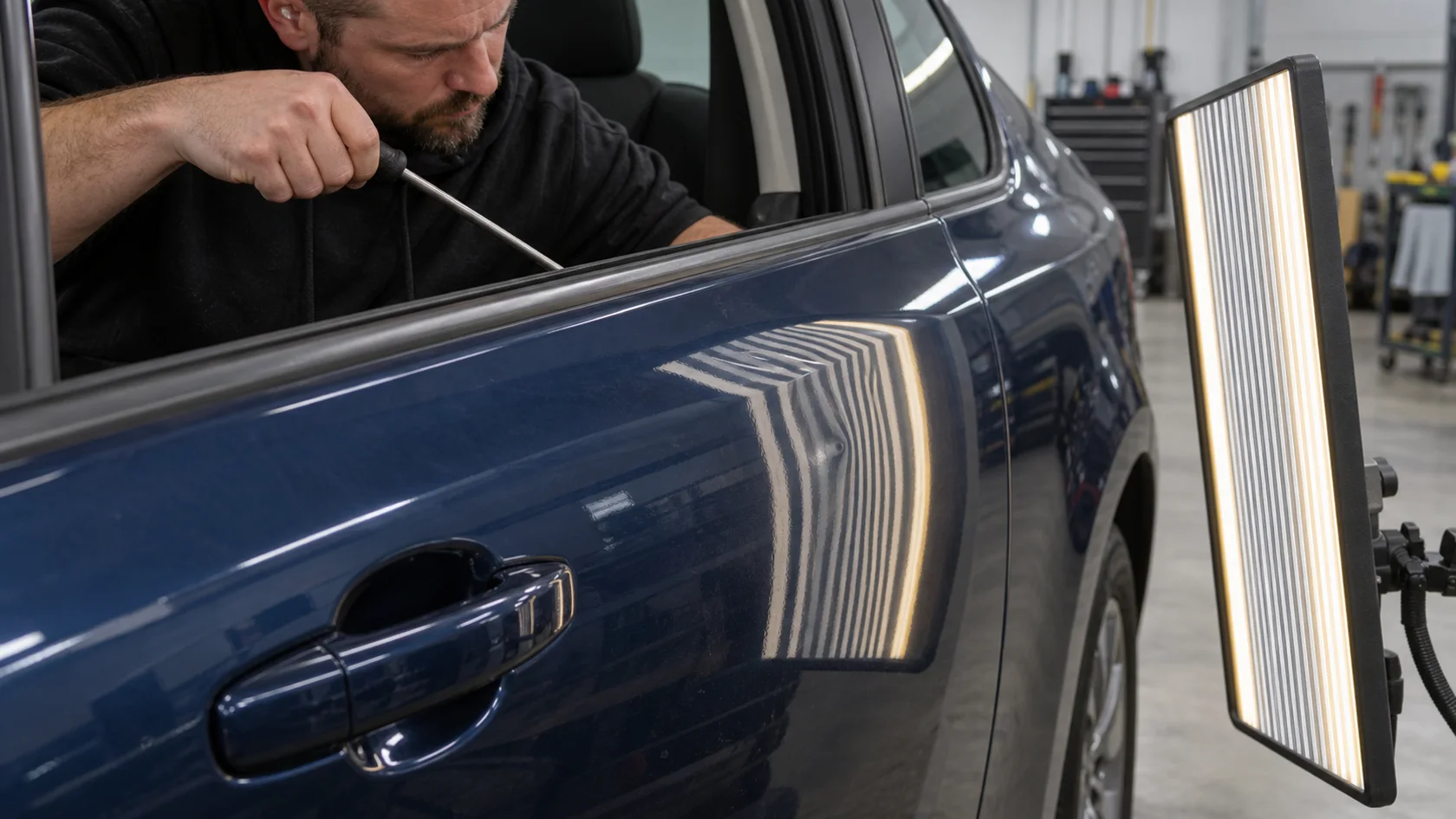
Precision comes from the reflection.The light pattern reveals the high and low points that ordinary shop lighting can miss.
Is PDR the right repair?
The paint, metal, location, and access all have a vote.
A small dent is not automatically simple, and a larger shallow dent is not automatically out of reach. We judge the panel as a complete repair problem.
PDR may be a good fit when
- The original paint is intact and firmly bonded
- The metal is displaced but not severely stretched
- The dent has workable access from behind or a suitable pull method
- The impact did not tear an edge or sharply crush a reinforcement area
Conventional repair may be better when
- Paint is cracked, chipped, split, or lifting around the dent
- The panel is sharply folded or the metal has lost too much shape
- The damage crosses an edge that cannot be restored cleanly with PDR
- Previous filler or repair material changes how the area can be worked
How the metal is moved
PDR is a series of small corrections, not one hard push.
A dent contains a low area, tension around its perimeter, and sometimes small crowns where displaced metal has collected. Correcting only the center can lock in distortion or create new highs.
We use reflected lines to read minute changes in the surface, then work the metal gradually. Depending on access and panel construction, correction may involve controlled pressure from behind, carefully managed pulling from the face, or a combination of methods.
- Read the dent
- Reflection lines reveal the true low point, crowns, depth, and direction of the impact.
- Plan safe access
- Trim, bracing, wiring, glass, and intrusion protection affect how the backside of the panel can be reached.
- Release tension gradually
- Small controlled movements bring the surface back while limiting stress on the paint and surrounding metal.
- Check the reflection again
- The panel is reviewed from changing angles because a dent can disappear in one view and remain visible in another.
Damage we assess for PDR
Similar-looking dents can behave very differently.
The label helps describe the damage, but repairability still depends on the specific panel and impact.
- Door dings
- Small parking-lot impacts can be clean candidates unless they sit on a sharp edge or damaged paint.
- Shallow dents
- Broad, soft impressions may retain good paint but can involve tension across a larger area.
- Creases
- Longer dents concentrate pressure along a line and require close attention at both ends.
- Hail marks
- Multiple roof, hood, and deck-lid dents require a panel-by-panel assessment of paint and access.
A repair choice, not a shortcut
Preserving paint matters only when the panel can be restored well.
PDR avoids unnecessary refinishing when the damage qualifies. It should not be used to force a compromised panel into a method that cannot deliver a clean, stable result.
Paintless dent repair questions
Straight answers about what PDR can and cannot do.
Is my dent a good candidate for paintless dent repair?
PDR is most suitable when the paint remains intact, the metal is not severely stretched, and the dent can be reached or safely pulled. We need to inspect the shape, depth, location, and panel material to confirm.
Can PDR fix a dent on a body line?
Sometimes. Body-line dents require more control because the panel is stiffer at the crease. Repairability depends on dent sharpness, paint condition, metal stretch, and tool access.
Does paintless dent repair damage factory paint?
The purpose of PDR is to reshape the panel while preserving sound existing paint. If the finish is cracked, split, poorly adhered, or already compromised, conventional repair may be the safer choice.
Can paintless dent repair remove hail damage?
Many hail dents can be repaired with PDR when the paint and panels qualify. The number, depth, location, and access requirements of the dents determine the repair plan.
Can PDR remove a sharp crease?
Some creases respond well, while others have stretched metal or damaged paint that prevents a clean PDR result. The ends of the crease and the deepest pressure point are especially important during assessment.
Why does access behind the dent matter?
Backside access lets a technician make controlled corrections at precise points. Bracing, intrusion beams, trim, and panel construction can limit that access or require a different method.
How much does paintless dent repair cost?
Price depends on dent size, depth, location, metal stretch, panel material, access, and the number of dents. Photos can help with an initial review, but an in-person inspection gives the clearest answer.
Let the panel decide
Find out whether your dent can keep its original finish.
Contact our Garden Grove shop with a few clear photos or bring the vehicle in for a closer look.