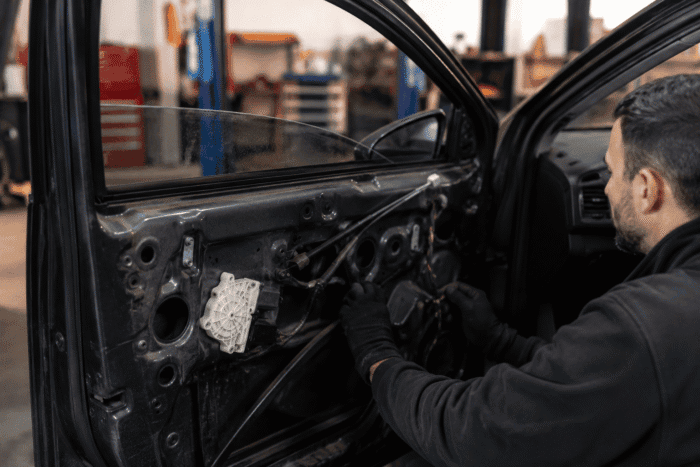
We get some version of this call almost every week: “my window won’t go up and I don’t even know what’s wrong with it.” Most people assume that means a glass problem, the same way a cracked windshield is a glass problem. Half the time it isn’t. The glass itself is usually the one part in that door that’s completely fine.
Auto window repair covers a wider range of actual problems than the search term suggests, and knowing which one you’ve got before you call around saves you money and a wasted trip. Here’s how we actually sort it out at the counter, and what each answer means for your wallet.
The First Thing We Ask: What Does the Window Actually Do When You Press the Button
Before we look at the car, we ask three questions on the phone. Does the window move at all, even a little? Does it make noise when you press the button? Did anything happen right before it stopped, like a kid leaning on the switch, a car wash, or nothing at all?
The answers point us in a direction before the vehicle even arrives. A window that moves an inch and stalls is a different repair than one that does nothing and makes no sound, and both are different from one that drops into the door with a bang. We’ve had customers show up expecting a full regulator replacement quote for a $15 fuse, and we’ve had the opposite, someone convinced it was “just the fuse” who actually needed a new motor. Neither guess was unreasonable. It’s just genuinely hard to tell from the driver’s seat.
Four Real Causes Behind a Window That Won’t Roll Up
Only one of the four causes we see regularly is actually a glass problem. The rest live inside the door.
The Glass Popped Out of Its Track
This is the one people picture when they hear “window repair,” and it’s genuinely the least common of the four in our experience. It happens most often on older vehicles where the plastic track clips have gone brittle, or after someone tried to force a stuck window down by hand. When the glass jumps the track, you’ll usually see it sitting crooked in the frame, sometimes tilted at a visible angle, and you can often hear a rattle from inside the door when the car hits a bump. This one really is a glass and hardware fix, seating the pane back into the regulator arm and replacing any broken clips. It’s a different job entirely from a windshield chip that can often be repaired in place, since side glass rides in a track and windshield glass is bonded flat into the frame.
The Regulator Failed
The regulator is the scissor-arm or cable mechanism that actually moves the glass up and down. It’s the most common failure we see on daily-driver vehicles with 80,000-plus miles, and cable-style regulators are the usual culprit. The cable frays over years of use, and when it finally lets go, the window either drops suddenly or stops moving with a grinding or clicking sound right before it fails. If your window recently started moving slower than usual, or making a new noise a few days before it quit, that’s a regulator on its way out, not a switch or fuse issue.
The Motor Is Dying, or Dead
Different symptom, different part. A dying motor usually shows up as a window that moves noticeably slower than the others in the car, especially in cold weather, or one that hesitates and needs a second press of the button to start moving again. A dead motor gives you nothing at all, no sound, no movement, when the regulator itself is fine. We’ve seen motors burn out faster on cars where a window’s been getting held against the button repeatedly, trying to force it past a spot where it was already sticking. That habit finishes off a motor that might have had another year left in it. This is worth knowing on newer EVs too, since Tesla and other EVs use frameless door glass that drops slightly every time the door opens, which means that motor is cycling more often than a traditional car’s window motor ever does.
It’s Actually the Switch, Not the Window at All
This is the one customers never guess and it’s more common than people expect, especially on the driver’s door master switch panel, which gets more wear and more spilled coffee than any other switch in the car. A bad switch can make a window seem completely dead when the motor and regulator are both fine. The tell is usually that the window works from a different switch, like the passenger door’s individual switch, but not from the driver’s master panel, or that it works intermittently if you wiggle the switch. This is also, by a wide margin, the cheapest of the four to actually fix.
What It Actually Costs, and Why the Range Is So Wide
People want one number and there genuinely isn’t one, because these are four different jobs with different parts costs.
- A switch replacement is typically the least expensive of the four, often a straightforward part-and-labor job on most vehicles.
- A motor replacement usually runs in the low-to-mid hundreds range depending on the vehicle, since the door panel has to come off either way and some cars require more disassembly than others.
- A regulator replacement, especially on vehicles where the motor and regulator are sold as one assembly, tends to land in a similar or slightly higher range, and German and some newer Japanese models generally run higher than older domestic vehicles because of part cost alone.
- Glass and track repair varies the most, since it depends on whether the glass itself survived being forced or dropped, or needs to be replaced along with the clips.
In our experience, the number one thing that turns a cheap fix into an expensive one is time. A regulator cable that’s fraying but hasn’t fully failed yet is a smaller job than the same cable after it snaps and the glass drops into the door and gets scratched or chipped on the way down. If a window is moving slow or making a new sound, that’s the window telling you it wants attention now, not in three months.
Is a Broken Power Window Something Your Insurance Will Cover
Almost always, no, and this catches people off guard. Regulators, motors, and switches wear out from age and use, and standard comprehensive and collision coverage doesn’t extend to mechanical wear and tear, only to specific covered events like collision, theft, vandalism, or weather. If someone broke into your car and the window glass itself is smashed, that’s a different story and comprehensive coverage typically applies. If the window just stopped working on its own, that’s on you the same way a worn brake pad or a dead alternator would be.
The one exception worth knowing: if your window quit working as a direct result of an actual collision, even a minor one, that repair usually does fall under your collision claim along with the rest of the body and structural work, since it’s tied to the accident rather than normal wear. If that claim also means you’re driving a rental while the car’s in the shop, the same rules and deadlines we’ve written about before apply here too, this repair doesn’t get special treatment just because it’s a smaller part of a bigger claim.
Can You Drive Safely With a Window Stuck Down, or Stuck Up
Stuck up isn’t a safety problem, just an inconvenience. Stuck down is a different conversation, and not just for the obvious reasons like rain and theft. Power window switches on modern vehicles are required to meet federal anti-entrapment standards, and the auto-reverse feature that stops a window before it can pinch a hand or a pet only works when the system is functioning correctly in the first place. A window with a failing switch or a regulator that’s binding partway through its travel isn’t reliably meeting that federal power window safety standard anymore, which matters most if you’ve got kids or pets who ride with a hand or paw near the glass. We tell customers with a stuck-down window and small kids in the car to get it looked at within a few days, not “whenever.”
What We Actually Check Before We Quote You
We don’t quote a regulator over the phone based on a description alone, because we’ve been wrong going off symptoms before and we’d rather not guess with your money. When your car comes in, we pull the door panel and check three things in order: power at the motor with a test light, whether the motor itself spins freely off the regulator, and whether the regulator moves smoothly through its full travel by hand once the glass is disconnected. That sequence tells us definitively which of the four causes above is the actual one, usually inside twenty minutes, before any part gets ordered.
If you’re getting quotes from more than one place, ask whether they’re diagnosing it this way or just quoting a regulator-and-motor assembly because that’s the safe guess. A shop that swaps the whole assembly without confirming the motor’s actually bad isn’t wrong exactly, it’s just charging you for parts you might not need.
Can a power window regulator be repaired instead of replaced?
On some vehicles, yes, especially if it’s just a frayed cable and the plastic carriage is still intact. On many newer cars the regulator and motor are sold as one sealed assembly, so a repair isn’t an option and it has to be replaced as a unit. We check the parts availability for your specific model before quoting either way.
Why did my window suddenly drop into the door?
That’s almost always a regulator cable or clip that finally gave out after fraying for a while, not a sudden random failure. If you noticed slower movement or a new noise in the days before, that was the warning sign. Don’t try to push the glass back up by hand, it can scratch or chip against the track.
Is it worth fixing a power window on an older car?
Usually yes if the rest of the car is sound, since a switch or motor repair is rarely the most expensive thing wrong with an aging vehicle. Where we tell customers to think twice is a car already close to end of life on other fronts, where the window fix alone isn’t worth sinking money into.
How long does auto window repair usually take?
A switch or motor swap is often same-day if the part’s in stock locally. A regulator on a harder-to-access door, or a special-order part on a less common model, can push it out a few extra days. We tell customers the honest timeline once we know which of the four causes it actually is, not before.