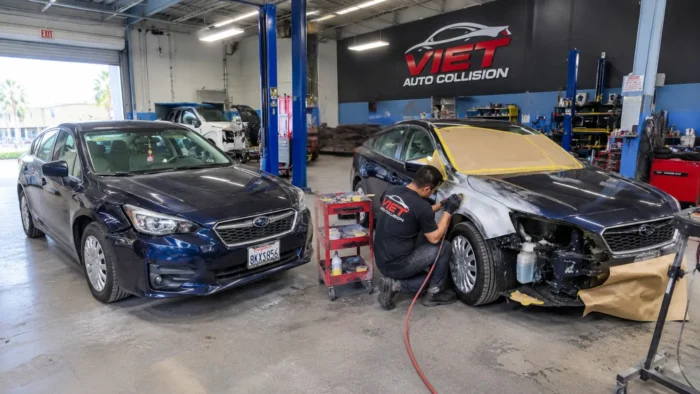
“The service advisor told me if I don’t let the dealer do the bodywork, my warranty is gone.” We hear some version of that on the phone every few weeks, usually from someone holding a two-year-old car with a crumpled fender and an estimate they’re afraid to sign. The short answer is that the warranty doesn’t disappear because an independent shop fixed the car. The longer answer, and the one nobody at the service desk tends to explain, is that there are a few specific situations where a collision can quietly shrink your factory coverage, and almost none of them have anything to do with whose sign is over the door.
The rule the service desk doesn’t mention
A federal law called the Magnuson-Moss Warranty Act has been on the books since 1975, and it’s the reason a manufacturer can’t tie your warranty to its own dealers. The FTC’s consumer guide on auto warranties puts it bluntly: it’s illegal for a dealer to deny coverage because repairs were done by someone else. The same guide says the manufacturer or dealer must prove an aftermarket or recycled part caused the damage before denying a claim over it.
That isn’t a dead letter, either. In 2015 the FTC finalized an order against BMW of North America over its MINI brand, requiring BMW to notify affected MINI owners that their warranties were not conditioned on dealer service or genuine MINI parts.
What the law does not do is make every future failure the manufacturer’s problem no matter what happened to the car. The standard is cause. If a repair or a part caused the failure, the manufacturer can decline that specific claim. It can’t decline the transmission because someone else painted the quarter panel. When a customer tells us a dealer “voided the warranty,” the first thing we ask to see is the written reason, because a real denial names a failure and a cause, not a shop.
The accident damage itself was never under warranty
This is the part that surprises people in the other direction. A factory warranty covers defects in materials and workmanship. It never covered crash damage in the first place. Toyota’s warranty booklet, which is typical of the industry, lists “fire, accidents or theft” at the top of its exclusions.
Where this bites is damage that shows up late. The classic example in our bay is the A/C condenser. It sits right behind the bumper, and a front hit that doesn’t look like much can bend its fins or put a pinhole in a tube. The air blows cold when the car leaves, then goes warm six weeks later. The owner takes it to the dealer expecting a warranty repair, the tech sees impact marks on the condenser, and the claim gets declined. That denial is correct, and it’s why we pressure-test and inspect the condenser on any front-end job with bumper reinforcement damage instead of assuming it survived. Catching it on the collision estimate means insurance pays for it. Catching it two months later usually means you do, and a condenser with the recharge typically runs several hundred dollars to around $1,200 depending on the car.
Four ways a collision can actually cost you coverage
The insurer paid it out as a total loss, even if the car got fixed
This one catches the most people, because the car can look perfect and still have lost its warranty. Toyota’s 2023 Warranty and Maintenance Guide excludes any vehicle that has ever been branded salvage or declared a total loss by an insurer, including cases where the insurer paid the claim instead of paying for repairs. Other brands use similar language. It doesn’t matter how well the car was rebuilt afterward.
That matters more every year. According to CCC’s Crash Course report, about 23% of auto claims in 2025 ended in a total loss, a record. Some of those owners keep the car, buy it back from the insurer, and have it repaired, sometimes by us. We tell every one of them before the work starts: the repair can be right and the factory warranty can still be gone. The emissions warranties and open safety recalls survive under Toyota’s wording, but the basic, powertrain, and restraint coverage does not. If you’re weighing whether to keep a car the insurer wants to total, that lost coverage belongs in the math, and it’s a big reason an EV totaled over what looks like minor damage is rarely worth buying back.
The repair itself caused the failure
“Improper repairs” is on every exclusion list, and here the manufacturer is on solid ground. What that looks like in real life is rarely dramatic. The things we find on cars that were fixed somewhere else and later had a warranty claim go sideways are almost always shortcuts:
- A wiring harness spliced with hardware-store butt connectors near a radar or camera, where the manufacturer’s procedure calls for a specific repair method or a new harness
- Airbag or seatbelt circuits spliced at all, which several manufacturers prohibit outright
- A radar or camera that was never recalibrated after a bumper or windshield replacement, so the system throws faults a month later
- Seam sealer and cavity wax left off the inside of a replaced panel, which is how rust starts from the inside out
Any of those gives a manufacturer a real, provable cause. A repair done to the automaker’s published procedure leaves them nothing to point at.
A non-genuine part is in the chain of failure
An aftermarket part on its own doesn’t void anything. Where it matters is when that part fails and takes something else with it. We’ve seen this exact sequence: an aftermarket condenser starts leaking and the A/C compressor runs low on oil and seizes. The compressor is a warrantable part on a newer car, but the manufacturer can decline that claim because a part it didn’t make caused the failure. The condenser’s own maker is on the hook for the condenser, and often nobody is on the hook for the compressor. We cover when used, new, or aftermarket parts make sense in more depth elsewhere, but for a car still under factory coverage, our strong preference is OEM parts on anything connected to a system the warranty still protects.
Rust-through coverage on a panel that was replaced
This is the quietest one. Toyota’s corrosion perforation warranty runs 60 months regardless of mileage, but it’s written to cover “any original body panel” that rusts through. Read literally, a new door skin we install is no longer an original panel, so its rust protection now comes from the replacement part’s own coverage and from how well the repair was sealed, not from the factory perforation warranty. That’s why we treat corrosion protection on replaced panels as non-negotiable: weld-through primer at the seams, seam sealer where the factory had it, and cavity wax inside closed sections. It’s also one area where your repair shop’s written warranty matters more than the factory’s.
Paperwork to keep so a future claim doesn’t turn into an argument
Nearly every warranty dispute we get pulled into comes down to one question: can anyone show the repair was done right? Six months later, memory doesn’t count. Paper does. Ask for these and keep them with your title:
- The final repair invoice with actual part numbers, not just “front bumper cover”
- The pre-repair and post-repair diagnostic scan reports
- Calibration printouts for any radar, camera, or sensor that was aimed or reset
- Photos of the damage before teardown, which prove what was and wasn’t hit
Also keep straight which warranty covers what. The factory warranty covers the car’s original defects. Your shop’s workmanship warranty covers the repair itself, and what a “lifetime” repair warranty actually covers has its own limits worth knowing. When something fails near a repaired area, the first question is which of the two it falls under.
If the dealer denies a claim and blames the repair
Don’t argue at the service counter. Work it in order:
- Get the denial in writing, with the specific failed part and the specific cause they’re claiming.
- Bring the repair file from the list above and ask them to show how that repair caused that failure. A vague “it’s been in an accident” isn’t a cause.
- Call the manufacturer’s customer relations line and get a case number. Regional reps overturn dealer-level denials more often than people expect.
- Use the manufacturer’s dispute program if that doesn’t work. Toyota’s booklet, for example, requires owners to go through its free arbitration program (a separate California program for California owners) before filing a Magnuson-Moss claim in court.
- If a dealer told you the warranty was void only because an independent shop did the work, report it to the FTC at ReportFraud.ftc.gov.
In our experience, when a denial actually names a cause, it’s usually a real one, and it’s usually a corner someone cut. When it doesn’t, it usually folds as soon as the owner asks for the reason in writing.
Does a body shop repair void my extended warranty?
Not automatically, but an extended warranty is usually a service contract, and it follows its own contract terms rather than the factory warranty’s rules. Most of the ones we see exclude collision damage and anything a claims inspector ties to a prior accident, so pull your contract and read the exclusions page before you assume a repaired area is still covered.
Will the dealer still do recalls on a car that was totaled?
Yes. Safety recalls follow the VIN, and even Toyota’s total-loss exclusion carves out open safety recalls. Run your VIN on NHTSA’s recall lookup before you buy back or buy a rebuilt car, since a car that sat in a salvage yard often has two or three recalls nobody did.
My car is leased. Do I have to use OEM parts?
Check your lease agreement, because that’s a contract question, not a warranty one. Many leases require repairs to manufacturer standards, and a turn-in inspector with a paint gauge will find a non-OEM bumper cover or a mismatched panel, so on leased cars we push for OEM parts on the estimate from day one.
Can the dealer tell my car has been in an accident?
Usually, yes. A paint thickness gauge reads refinished panels in seconds, and a vehicle history report often shows the claim. That’s fine, since a repair history by itself isn’t grounds for a denial. What protects you is being able to show the repair was done to procedure.