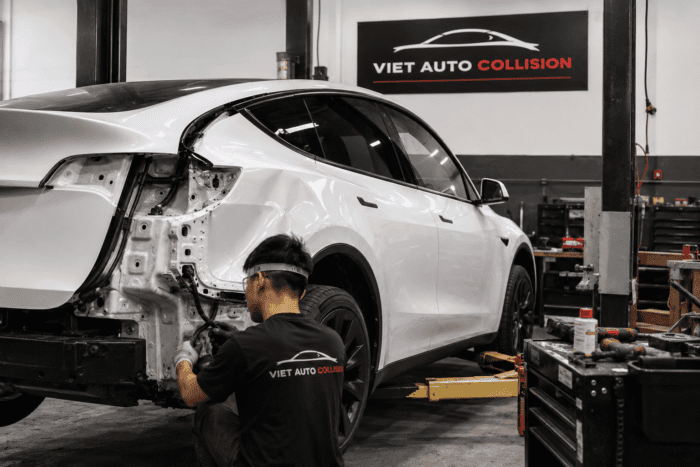
Orange County has one of the highest concentrations of Teslas and other electric vehicles in the country, and that shows up in our bay every month. What most EV owners don’t realize until they’re standing in the estimate line is that collision repair on their car doesn’t work the same way it does on a gas-powered vehicle. The parts are different, the safety procedures are different, and the technician working on your car needs training that a typical body shop simply doesn’t require. Here’s what actually happens, step by step, and why it matters for your timeline, your wallet, and your safety.
Why EV Collision Repair Isn’t Just Regular Body Work
A fender bender on a Tesla or any other EV triggers a different set of questions than the same accident would on a Camry or an F-150. Before a technician even picks up a tool, the shop has to account for a battery pack that can carry several hundred volts, an aluminum-heavy structure in some models, and camera and radar systems that steer the car.
The High-Voltage Battery Is the First Thing That Changes
Federal safety standards require that an EV’s high-voltage system either isolate itself electrically, drop to a safe voltage, or stay physically shielded after a crash. That’s the baseline the vehicle is designed to meet. But “designed to meet” and “confirmed safe to work on” are two different things, and a shop has to verify the battery is actually de-energized before any structural or body work starts. Skipping that step isn’t a shortcut, it’s a real electrical shock and thermal runaway risk to the technician.
More Labor Hours, More Specialized Equipment
Industry repair-cost data has found that EVs require nearly double the labor hours of a comparable gas vehicle on many claims, largely tied to the process of isolating and often removing the high-voltage battery before other work can begin. Add in aluminum repair equipment that has to stay separate from steel repair tools to avoid cross-contamination, and you’ve got a job that simply takes longer to do correctly.
What Actually Happens When You Bring an EV or Tesla In
The process follows a specific order, and skipping steps is where shortcuts turn into safety problems or comeback repairs. A shop that’s actually set up for EV work moves through it roughly like this:
- High-voltage safety check. A trained technician confirms the battery is isolated and safe to work around before anything else happens.
- Damage assessment and teardown. The vehicle is disassembled enough to see the full extent of damage, including anything hidden under trim or behind the bumper cover.
- Battery and structural inspection. The battery enclosure, mounting points, and surrounding structure get checked for damage that isn’t visible from the outside.
- Structural and body repair. Using OEM procedures and the correct equipment for the vehicle’s specific materials, whether that’s aluminum, high-strength steel, or a mix.
- Paint and refinishing. Color-matched to factory specification, a step that matters as much on an EV as on any other vehicle.
- ADAS and camera calibration. Cameras, radar, and sensors that support driver-assist features get recalibrated to the manufacturer’s exact specs.
- Final high-voltage system check. The vehicle is re-verified as electrically safe before it goes back to the customer.
Several of these steps, especially the battery inspection and final safety check, simply don’t exist on a gas vehicle’s repair order. That’s a meaningful part of why the timeline and invoice look different.
Why the Technician’s Certification Level Matters
Not every body shop is equipped, or trained, to touch a high-voltage vehicle. This is one area where asking questions before you drop off your car actually protects you.
High-Voltage Technician Training Levels
Collision repair training organizations, including I-CAR’s high-voltage safety program, structure EV certification in tiers, ranging from technicians who aren’t cleared to touch any high-voltage component even after the battery is isolated, up to those trained and equipped to work under live conditions when a manufacturer’s procedure calls for it. Manufacturers set their own specific requirements on top of that baseline, and proper personal protective equipment, including insulated gloves rated for the voltage involved, is required at every level. A shop that can’t speak to which level its technicians hold isn’t the right shop for this job.
Questions Worth Asking Before You Drop Off Your EV
- Are your technicians high-voltage certified, and at what level?
- Do you have a dedicated, isolated area for working on high-voltage vehicles?
- Will you use OEM parts, and can you explain why for a battery-electric vehicle specifically?
- Who performs the ADAS calibration, in-house or a sublet specialist, and how is that documented?
- Can you show me documentation that the high-voltage system was verified safe before delivery?
Any shop that’s genuinely set up for this work should answer these without hesitation. Our technicians hold I-CAR credentials and we’re transparent about what’s in-house versus what gets handled by a manufacturer-approved specialist.
What EV Collision Repair Actually Costs
There’s no way around it: EV collision repair tends to run higher than a comparable repair on a gas vehicle. A recent industry cost analysis, covered by Green Car Reports, found EV repairs running roughly 20 percent higher on average than comparable gas-vehicle claims, with some studies putting the gap even higher depending on the make and model involved. A few things drive that gap:
- Battery pack components and enclosures, which are expensive and often require full removal even for inspection
- Sensor and camera hardware tied to driver-assist systems, which need recalibration after almost any front-end or windshield work
- Nearly double the labor hours on many claims, largely from high-voltage isolation and de-energization procedures
- Specialized aluminum repair equipment and dedicated bay space that traditional steel-focused shops don’t carry
None of this means every EV repair is dramatically more expensive. A minor bumper cover scuff with no sensor involvement can still be a straightforward job. The cost gap shows up most on repairs involving the battery area, structural components, or anything near a camera or radar module.
OEM Parts and Insurance on an EV Claim
Parts sourcing and insurance negotiations look a little different once a battery-electric vehicle is involved.
Why OEM Parts Carry More Weight on an EV
Aftermarket parts save money on a lot of repairs, and there are cases where they’re a perfectly reasonable choice. On an EV, though, structural components and anything near the battery enclosure or crash sensors carry tighter tolerances, since a poor fit can affect how the vehicle protects the battery in a future collision or how accurately a camera reads the road. That’s a big part of why EV manufacturers push OEM-first repair procedures so strongly for anything structural.
Working With Your Insurer on an EV Claim
Insurance companies are still catching up to how EV claims actually work, and it shows in how estimates get written. A supplement request for a battery inspection or an ADAS calibration that wasn’t on the initial estimate is common, not a red flag. We’ve walked plenty of Garden Grove drivers through this exact conversation with their adjuster, and we’ve written more detail on the general insurance claim process for collision repair if you want the fuller picture beyond the EV-specific pieces here. If your policy doesn’t already include OEM parts coverage, it’s worth checking with your agent, since some insurers only cover aftermarket parts by default on vehicles past a certain age.
How Long Does EV Collision Repair Actually Take?
A straightforward bumper repair with no battery or sensor involvement might move on a similar timeline to any other vehicle, often a matter of days. Once the repair touches the battery enclosure, structural components, or requires ADAS calibration, and especially if it’s a Tesla and any parts are on backorder, timelines can stretch to several weeks. Camera and radar calibration alone often needs a specific target setup and enough clear space, which not every shop has on hand. This is one more reason the front-end conversation about certification and equipment matters before work starts, not after.
Choosing a Shop for Tesla or EV Collision Repair in Garden Grove
A few things separate a shop that’s genuinely equipped for this work from one that’s willing to take the job anyway:
- Documented high-voltage technician training, not just general ASE or I-CAR credentials
- A dedicated aluminum repair area, separate from steel repair equipment
- In-house or clearly sourced ADAS calibration with documentation you can keep for your records
- A straight answer on OEM versus aftermarket parts and why, specific to your vehicle
- Experience actually working EV claims with insurers, not just gas-vehicle claims
We’ve built our Tesla and EV repair process around these exact points, and we’re upfront when a repair is outside what we can safely handle in-house. If your EV also needs a windshield replaced as part of the repair, it’s worth knowing that most forward-facing cameras live on or near the glass, which is part of why we walk through when windshield damage actually needs replacement versus repair as its own conversation with EV owners specifically.
If your Tesla or EV was just in an accident, the most useful first step is getting a real technician to look at the high-voltage system and the visible damage before you assume anything about cost or timeline. Give us a call and we’ll walk you through what your specific repair actually involves.