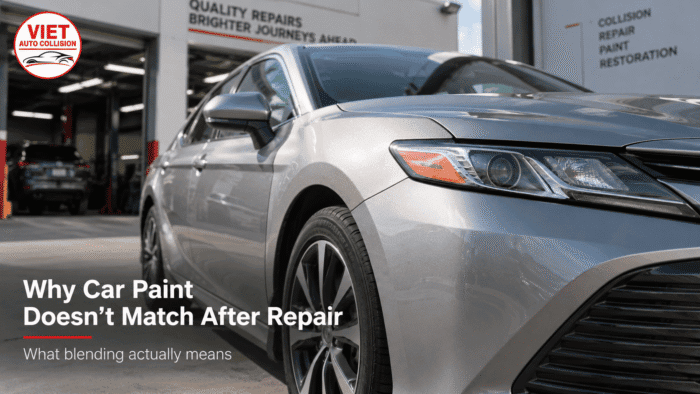
A customer walked around his Camry in our parking lot last week, out in real daylight, and asked us straight up: “Did you guys even paint this?” We had. The front bumper and the fender next to it were the correct factory color, mixed right, sprayed right, cured right. It still looked slightly off next to the door behind it. That’s not a bad paint job. That’s what happens when only the damaged panel gets refinished and the panel next to it doesn’t, and it’s one of the most common calls we get on a collision repair that otherwise went fine. If the damage never needed paint in the first place, this whole problem doesn’t apply, which is one of the real advantages of a repair like paintless dent repair when a dent qualifies for it. Once paint has to go on, though, matching it correctly is its own separate job.
Why a Repaired Panel Almost Never Matches on Its Own
Paint your fender the exact factory color code and it still won’t necessarily match the fender sitting six inches away from it. Three separate things work against a single-panel repair at once, and none of them are the shop doing something wrong.
Paint That’s a Few Years Old Doesn’t Look Like the Can It Came From
Every panel on your car has been sitting in the sun since the day it left the factory. UV breaks down clear coat over time and slowly shifts the base color underneath it, reds especially, and a car that’s spent five or ten years in a driveway has drifted a shade or two off its own factory code without anyone noticing, because the whole car faded evenly together. New paint mixed to that same factory code goes on looking exactly like the formula says it should. That’s the problem. It’s matching a number on a chip, not the actual faded panel sitting next to it.
Metallic and Pearl Flake Move With the Light
Solid colors are forgiving. Metallic and pearl are not, because the aluminum flake or pearl pigment in the paint settles at a slightly different angle depending on how it’s sprayed, and that angle changes how the color reads as you walk around the car. We hold a sprayout card at three angles under the booth lights before we ever put a coat on the actual panel, because a formula that looks dead-on straight overhead can read half a shade warmer or cooler at a 45-degree angle, and a 45-degree angle is exactly where you’re standing when you glance at your own bumper in a parking lot.
Matching Under Booth Lights Isn’t the Same as Matching in the Sun
Color scientists call this metamerism: two colors that look identical under one light source and visibly different under another. Our booth lights are calibrated close to daylight, but they’re not actual daylight, and a match that looks perfect under them can show a faint shift once the car’s parked in your driveway at five in the afternoon. There’s no lighting fix for that. It’s exactly why fading the color into the next panel, rather than trying to hit a hard, exact break at a body line, is the actual solution here, not a shortcut some shops take to avoid real work.
Single-Panel Refinish vs. a Blended Repair: Two Very Different Jobs
Every collision estimate starts from a “refinish only” line on the damaged panel by default, and it’s worth understanding what that line actually buys before you assume more paint automatically means a better repair.
What “Refinish Only” Actually Covers
Refinish only pays to strip, prime, base coat, and clear coat the one panel that got hit, full stop. It’s the cheapest, fastest version of the job, typically a few hundred to around a thousand dollars depending on the panel, and for plenty of solid colors on a panel with a hard break line, a molding, a trim piece, or a body crease that naturally separates it from the next panel, it’s genuinely enough. We’re not going to talk a customer into more work than that when the break line and the color both cooperate.
What Blending Adds, and Why It Usually Has To
Blending means we carry the new base color past the repaired panel’s edge into the panel next to it, fading it out gradually instead of stopping at a hard line, then clear-coat both panels together so there’s no visible seam where old paint meets new. It typically adds a few hundred dollars per panel on top of the refinish line. It isn’t extra work for the sake of it. On any panel that doesn’t have a clean break line, skip it and you get exactly the parking lot problem from the top of this piece. When the color’s forgiving and the break line is clean, we say so and don’t charge for a blend nobody needs.
Why Insurance Doesn’t Always Pay for It Automatically
Here’s the part most customers never hear at the counter. The estimating software running nearly this entire industry, CCC, Mitchell, and Audatex between them cover almost every shop and insurer in the country, defaults to refinish only on the damaged panel and treats a blend on the panel next to it as a separate line a shop has to add and justify on its own, usually by pointing to the paint manufacturer’s own color-match procedure calling for it on that specific color.
For years, even when a shop did get a blend line approved, the software was underpaying for it. A blend-time study conducted through the Society of Collision Repair Specialists found that the industry-standard formula, which paid blend panels at roughly half the labor time of a full panel refinish, was underestimating the actual work by about 31.6 percent. CCC changed its formula in 2023, and Mitchell followed with its own change in 2024, both moving to a variable time factor instead of the flat fifty percent number shops had been arguing against for years. That’s not a small industry footnote. It’s the actual reason blending got treated as a corner-cutting option for so long: the number in the software never reflected the real labor.
Paint and materials work out to a modest slice of the total bill industry-wide, Mitchell’s own appraisal data has put it around a tenth of the average estimate, which is part of why a few hundred dollars of blend time is an easy line for an adjuster to cut if nobody pushes back with real documentation. We write the paint maker’s color-match procedure directly into the supplement when we submit it, because an adjuster is far more likely to sign off on a line item backed by the manufacturer’s own paperwork than a shop’s word that “it needs it.” That’s also the underlying standard behind California’s fair claims settlement regulations for auto insurance, which require a repair to actually return the car to its condition before the loss, not just the cheapest version that technically closes the file. Most of the time citing the procedure gets the blend through. When it doesn’t, we tell the customer exactly what got denied and what the honest trade-off looks like: cover the blend difference out of pocket, or accept a repair that meets the insurer’s minimum standard but might not disappear the way you’re picturing it.
When a Blend Isn’t Enough
Blending gets the job done on most repairs. It isn’t the answer to every one of them, and pretending otherwise just moves the disappointment further down the road.
Double Blends on Tight Color Ranges
Some factory colors, certain dark reds and a handful of silvers especially, sit close enough to their neighboring shades that a single blend panel still leaves a faint line where it fades into the next one over. On those we’ll double blend, carrying the fade across two panels instead of one so the transition has more room to actually disappear. It adds real labor and material cost, and we say so on the estimate up front rather than letting it show up as a surprise on a supplement later.
When We Tell a Customer to Just Repaint the Whole Panel
Once in a while the honest answer is that blending isn’t going to get there at all, usually on a car that’s had prior bodywork somewhere else that we didn’t do, mismatched paint already sitting on an adjacent panel from an old repair, or a color the manufacturer has quietly reformulated since the car was built. This is basically the same blend-versus-full-panel debate the trade press covers from the shop’s side of the counter, just with an actual customer standing in front of us instead of an adjuster on the phone. In those cases we’d rather tell a customer up front that a full panel respray is the only version of this that actually holds up than sell a blend we already suspect won’t. And once we’re already clearing a full panel down to bare metal for paint, that’s also the point where our paint and refinishing team checks the panel edges for anything the original estimate missed.
What to Actually Ask For Before You Sign the Estimate
A few questions at the counter save most people this entire headache before it starts:
- Ask whether the estimate includes blending on any panel next to the repair, not only the damaged one.
- Ask specifically if your color is metallic, pearl, or tri-coat, since those are the finishes most likely to need it.
- If blending was denied by the insurer, ask to see what was actually cited, so you know whether it’s a documentation gap or a genuine judgment call on that specific claim.
- Walk the car in real daylight before you sign off on the finished repair, not just under the shop’s own lights.
None of that is a complaint when you bring it up at the counter. It’s a normal question, and any shop that treats it like an accusation is telling you something about how the rest of the job is going to go. It’s also worth giving fresh paint the right amount of time before you judge the match or take it through a wash, since cure chemistry affects how a blend settles in the same way it affects how soon you should wash or wax after any paint job, and a panel that’s been sitting through an active wildfire ash season without the right wash routine can pick up its own separate etching that has nothing to do with the original color match at all.
Why doesn’t my car paint match after a repair?
Usually because only the damaged panel was painted and the panel next to it wasn’t blended in with it. New paint mixed to the factory code goes on looking exactly like the formula, while the panel beside it has faded or shifted slightly with age, and metallic or pearl colors make that gap more visible depending on the angle you’re viewing it from.
Will my insurance pay to blend the panel next to my repair?
Most of the time, yes, if the paint manufacturer’s own color-match procedure for that color calls for it and the shop cites that procedure in the estimate. If a shop doesn’t ask for it up front, plenty of adjusters won’t add it on their own, so it’s worth asking directly whether blending is already included before you sign.
Can I ask for a full panel repaint instead of just a blend?
You can ask, but we’ll tell you honestly whether it’s actually needed. On a clean color with a natural break line, a blend usually looks identical to a full respray for a lot less money, and we’re not going to upsell a full panel job you don’t need. When the color’s tight enough that a blend genuinely won’t disappear, we’ll say so and recommend the full panel ourselves.
Does paint blending cost extra?
Yes, it’s a separate labor and material line from the damaged panel’s refinish, typically a few hundred dollars per panel depending on the color and how much surface has to be prepped and cleared. It’s usually far cheaper than a full panel respray, which is exactly why it’s the right call whenever the color allows for it.
Why is metallic or pearl paint harder to match than a solid color?
Because the metal flake or pearl pigment in the paint reflects light differently depending on the angle it was sprayed at, so the same formula can read a little warmer or cooler depending on where you’re standing. Solid colors don’t have that flake catching the light differently, which is why they’re far more forgiving to match from one panel to the next.