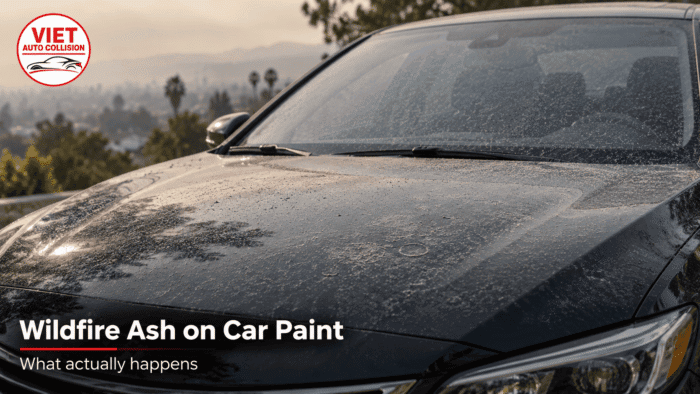
We had three cars in the bay in one week last fall with the same complaint, and none of them had been in an accident. Two hoods and a roof, all with a fine, cloudy haze that wouldn’t buff out with a normal wash. All three owners said the same thing: “I just haven’t washed it since the smoke.”
That’s the pattern every time fire season kicks up in Southern California. Ash lands on a car, sits there for a few days because nobody wants to wash a car during a smoke advisory, and by the time it does get washed, some of the damage is already done. The ash itself isn’t the mystery. What actually happens to your paint while it’s sitting there, and what’s worth doing about it, is the part most people never get a straight answer on.
Why Ash Is Worse Than It Looks
Ash looks like fine, harmless dust. It isn’t. It’s a mix of burned plant material, building material, and mineral residue, and it causes damage two completely different ways depending on whether it’s dry or wet. We treat those as two separate problems in the bay because the fix for one makes the other worse if you’re not careful.
The Abrasive Problem: It’s Scratching You Before You Even Touch It
Dry ash is gritty at a microscopic level, closer to fine sand than to pollen or road dust. The instinct almost everyone has is to grab a towel and wipe it off the hood before it “gets worse.” That’s the single fastest way to put swirl marks into a clear coat. Every pass of a dry towel drags those grit particles across the surface, and on a black or dark-colored car you’ll see the damage under sunlight within a day or two as a web of fine scratches that wasn’t there before. We see this constantly on the darker vehicles that come in during a bad fire week. It’s almost always self-inflicted, from someone trying to do the responsible thing and wipe the car down before work.
The Chemical Problem: What Ash Does Once It Gets Wet
The second mechanism is slower and less obvious. Wildfire ash carries alkaline minerals, calcium and potassium being the two we hear about most from paint suppliers, and those minerals are largely inert while the ash stays dry. Add moisture, morning dew, marine layer fog, a light drizzle, and the ash turns into a mild caustic slurry sitting directly on your clear coat. Left there overnight or across a hot afternoon, that slurry can etch into the clear coat itself, not just sit on top of it. Etching isn’t a stain you can wash away later. Once the surface has been chemically altered, it needs to be corrected, not cleaned.
The California Contractors State License Board actually put out an industry bulletin on this exact issue for fleet and construction vehicles, warning that ash left on a vehicle can eat into paint and clear coat, and that it needs a soft cloth or duster rather than a hard wipe. The same guidance applies to any car parked outside during a smoky stretch, not just work trucks.
How We Get Ash Off a Car Without Making It Worse
The order matters more than the products. Skipping a step, especially the rinse, is what turns a five-minute wash into a paint correction job two weeks later.
- Rinse first, top to bottom, before anything touches the panel. A hose on a wide fan pattern or a pressure washer on a low setting floats loose ash off without dragging it. Start at the roof and work down so you’re not re-depositing ash from the hood onto a panel you already rinsed.
- Use a pH-balanced wash soap, not whatever’s under the sink. A neutral or slightly acidic car shampoo helps counteract the alkaline ash instead of adding to it. Dish soap and generic degreasers strip wax and sealant, which removes the one layer of protection the paint had.
- Two-bucket method, soft mitt, minimal pressure. One bucket for clean soap, one for rinsing the mitt before it goes back in the soap. This keeps grit out of the wash water instead of grinding it back into the paint on the next pass.
- Dry with a clean microfiber towel, patting rather than dragging. Any leftover grit gets pushed across the surface with a wipe, not lifted off.
- Reapply a wax, sealant, or ceramic topper once the car is clean. That layer acts as a sacrificial barrier for the next round of ash, which matters because most fire seasons here run in waves, not one event.
Don’t wait for a clear day to do this. We’d rather see a customer wash a car during a moderate smoke advisory using this method than wait a week for clean air and let the ash sit through two or three dew cycles in the meantime. This is the same pH-balanced, two-bucket routine we run on any standard auto detailing visit, just done with more urgency during an active fire event.
How to Tell the Damage Already Happened
Run your hand flat over the hood and roof after washing, not looking, feeling. If the paint feels gritty or slightly rough instead of glass-smooth, that’s usually early-stage bonded contamination or light etching, not just a spot you missed with the towel. Under direct sun, etching shows up as a dull, hazy patch that doesn’t restore with a normal wash and wax, sometimes with faint water-spot-shaped rings where a dew droplet sat and dried. Horizontal panels take the worst of it: hood, roof, trunk lid, the tops of the front fenders. Vertical panels like doors mostly just get dusty.
If you’re not sure, the clay bar test tells you fast. Wash the panel, then run a piece of detailing clay lightly over it. If the clay drags or catches instead of gliding, there’s bonded contamination sitting in the clear coat that a wash alone won’t remove.
Does Insurance Actually Cover This
Comprehensive coverage is the right coverage for this, not collision, since nothing hit the car. Fire and its aftermath are named perils under most comprehensive policies. The catch isn’t whether it’s covered in principle. It’s proving the damage came from ash specifically and not from a car that just hasn’t been washed in six months.
Take photos of the ash actually sitting on the car before you wash it off, with a timestamp, ideally with something in frame that shows the smoke conditions that day. Keep a note of the active incident dates for the fire in question, since that’s the record an adjuster will check your claim against. If the etching only shows up after washing, that timeline (ash visible on this date, etching found after washing on this date) is what an adjuster is actually looking for. Most comprehensive deductibles here run somewhere in the $250 to $500 range, so for a single light-etched panel that a polish would fix for a couple hundred dollars, filing a claim usually isn’t worth it once you account for the deductible and a potential rate impact. It starts making sense once you’re looking at multiple panels or a full correction.
When It’s Past a Wash and Into Paint Correction
A wash and a fresh coat of wax handles surface ash every time, no exceptions needed there. Correction becomes the conversation once etching has actually set into the clear coat, which a wash can’t undo no matter how good the soap is. We start by measuring clear coat thickness with a gauge before touching a buffer, because a car that’s already had a repaint or two has less clear coat to work with, and machine polishing removes a small amount of material every pass. Light, single-stage polishing handles surface haze and shallow etching on original paint. Deeper etching, or a car with thin clear coat from a prior repaint, sometimes needs wet sanding before polishing, and that’s not a job we hand to a general detailer, it goes through paint and refinishing instead.
A single hood-and-roof correction on light etching typically runs a few hundred dollars in labor. A full car that sat through a bad ash week without a wash can run past a thousand once you’re correcting every horizontal panel and reapplying protection afterward. In the rare case where etching is deep enough that a panel needs an actual respray rather than polishing, the same curing-time rules we’ve covered for a fresh paint job apply before that panel goes back outside into more ash. And if the etched panel happens to be one we repainted for you previously, that’s not something our workmanship warranty covers either, since it’s environmental damage after the fact, not a defect in the original repair. We’d rather tell a customer honestly that their car only needs a wash than sell a correction it doesn’t need, and just as often we tell someone the opposite, that what they’re calling “a water spot” is actually etched in and a wax job isn’t going to fix it.
Can I just wipe wildfire ash off with a dry towel if I’m in a hurry?
No. Ash is abrasive at a microscopic level, closer to fine sand than dust, and a dry towel drags that grit across the clear coat. Rinse it off with water first, even a quick hose-down, before anything touches the panel.
How long can ash sit on my car before it actually causes damage?
Dry ash by itself isn’t doing much. The clock really starts once moisture hits it, one overnight dew cycle or a stretch of marine layer fog is often enough to start etching. In practice, we tell customers not to let a car sit unwashed more than two or three days during an active fire event.
Is wildfire ash worse for paint than normal dust or pollen?
Yes, in two ways at once. It’s grittier than dust, so it scratches more readily, and unlike pollen it carries alkaline minerals that turn corrosive once wet. Pollen washes off clean. Ash can chemically etch the surface if it’s left to sit through a wet cycle first.
What if it already rained and the ash is baked on?
Don’t scrub at it dry to try to break it loose. Soak the panel with a pH-balanced soap for a few minutes to loosen the residue before any contact, then rinse and wash as normal. If it still feels gritty after that, run the clay bar test before assuming a wax will fix it.
Will my workmanship warranty cover ash etching on a panel you recently repainted?
No, and this comes up more than you’d think right after a fire week. A workmanship warranty covers defects in the repair itself, not environmental damage that happens afterward. Ash etching on a repainted panel gets treated the same as it would on original paint, as a correction job, usually comprehensive-claim territory rather than a warranty callback.