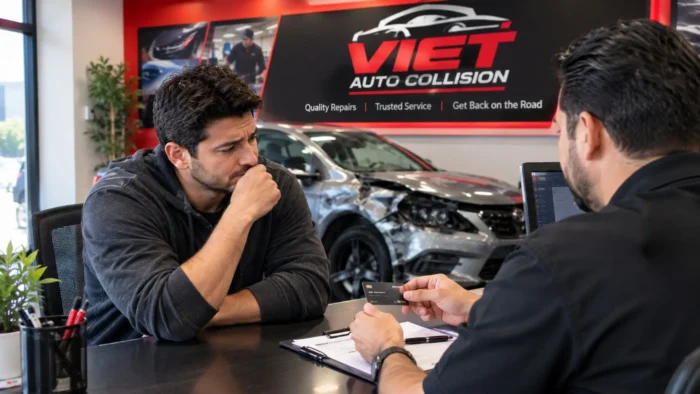
We hear this one at the front counter almost weekly: someone drops their car off after a wreck that was clearly not their fault, police report already filed, other driver’s insurance already on the phone with them, and they still get a call from the rental counter asking for their own credit card and a deposit. Most people assume something went wrong. It usually didn’t. It’s just how the timeline actually works, and almost nobody explains it before it happens.
Why the Other Driver’s Insurer Can’t Just Start Paying on Day One
Liability isn’t decided the moment a police report gets filed, even when the report looks completely one-sided. The at-fault driver’s insurance company still has to open a claim, assign an adjuster, and formally accept responsibility before they’ll authorize anything, including a rental.
California actually puts a number on how long that’s allowed to take. Under the state’s Fair Claims Settlement Practices Regulations, Title 10 CCR §2695.5 gives an insurer 15 calendar days just to acknowledge that a claim came in. Section 2695.7 then gives them up to 40 calendar days after receiving proof of loss to accept or deny the claim outright, and if they need more time than that, they’re allowed to send a notice saying so and keep the file open. None of that is unusual or a sign the adjuster is dragging their feet on purpose. It’s the actual legal window they’re operating inside, the same set of regulations behind the storage-fee clock we’ve covered on the tow-yard side of a claim.
What that means in practice: on day one or two, the other driver’s insurer often hasn’t formally accepted anything yet, even in a case where fault is obvious to everyone involved, including their own adjuster. Until they do, there’s no authorization for the rental company to bill against. We’ve had customers show up to pick up a car the same afternoon as the tow-in, expecting the rental to already be squared away because “the other guy admitted it,” and get turned away at the counter because that admission hasn’t turned into a claim number and an authorization yet.
What “Direct Bill” Actually Means, and Why It Isn’t Automatic
“Direct bill” just means the rental company invoices the insurance company directly instead of charging you and waiting for you to get reimbursed later. It sounds like it should happen by default once there’s a claim. It doesn’t, because it requires an actual agreement between that specific adjuster’s file and that specific rental branch, set up on purpose, not assumed.
When It’s Already Set Up Before You Arrive
If the at-fault insurer’s adjuster has already called the rental company, given them a claim number, and confirmed daily rate and duration limits, the counter usually just needs your ID and proof you’re the person named on that authorization. This is the smooth version, and it does happen, especially once liability is clearly accepted and the adjuster is experienced with that particular rental branch.
When It Isn’t Yet, Which Is the More Common Day-One Situation
If none of that has happened yet, and it usually hasn’t in the first day or two, the rental counter has no authorization to bill against. At that point they treat you like any other renter: their own credit card, their own deposit, their own signature on the rental agreement. This isn’t the rental company being difficult. They have a car to protect and nobody on file yet who’s agreed to pay for it if something goes wrong during the rental.
Our own rental coordination page puts the distinction plainly: a reservation and an insurance authorization are not the same thing. We can help line up timing around your repair schedule, but we don’t control whether or when a policy authorizes payment. That decision sits entirely with the insurer.
The Deposit on Your Card Isn’t the Insurance Company Charging You
This is the part that causes the most confusion, and it’s worth separating clearly. The daily rental rate is what the insurance claim is supposed to cover, once it’s approved. The deposit is a completely separate hold the rental company puts on your card, and it exists whether or not an accident is involved. It’s the same deposit anyone pays picking up a rental car for a vacation.
| Direct bill already set up | Direct bill not set up yet | |
|---|---|---|
| Whose card is on file | Yours, for incidentals only | Yours, for the full rental |
| Typical hold amount | Often a token amount, commonly around $50 | A full security deposit, commonly $200 to $300 |
| When it’s released | At return, once the car’s checked in clean | At return, or once the insurer’s payment posts and covers the charge |
That hold covers things the insurance claim was never going to pay for anyway: a full tank returned empty, a toll transponder that gets used, a scratch that shows up during the walkaround, an extra day if the repair runs long and nobody called to extend it. We tell customers the same thing every time this comes up: that hold isn’t proof you’re paying for the accident. It’s the rental company’s standard protection, and it comes off your card whether the claim is airtight or not.
What To Do When the At-Fault Insurer Is Slow to Accept Liability
A slow adjuster is genuinely frustrating, but there are a few things that actually move it along instead of just waiting:
- Get the claim number from the at-fault insurer as early as possible, even before liability is formally accepted, and give it to the rental counter yourself. It’s often enough for them to start the file even if billing authorization comes a few days later.
- Ask the adjuster directly whether they have a direct-bill relationship with the rental branch you’re using. Some do and some don’t, and the adjuster usually knows immediately.
- Keep every rental receipt if you end up paying out of pocket for a few days before authorization comes through. Reimbursement for that gap is exactly what California’s “reasonable time” requirement under CCR §2695.8 is meant to cover once liability is accepted, but it’s much faster to collect on with dated receipts in hand.
- If your own repair estimate changes once we get the car apart, which happens on a real percentage of jobs once hidden damage shows up during teardown, that supplemental review can add a few more days to the insurer’s side. It’s the same kind of documentation timeline that ends up mattering later if a repaired car is ever worth pursuing a diminished value claim over, so it’s worth asking early whether a supplement is likely for your specific damage.
- A shop that’s already documenting the repair for the at-fault carrier, which is what our own insurance claims assistance work amounts to, can usually forward the same photos and estimate toward the rental authorization instead of that paperwork starting from zero. It doesn’t force the adjuster’s hand, but it removes one excuse for the delay.
Using Your Own Rental Reimbursement Coverage as a Bridge
If you added rental reimbursement to your own policy, and a lot of people don’t realize they even have it until this exact moment, you don’t have to wait on the other driver’s insurer at all. Your own insurer can put you in a rental right away under your own coverage, subject to whatever daily and total caps are on your policy, commonly somewhere in the range of $30 to $50 a day for a limited number of days according to typical rental reimbursement endorsements, a point the California Department of Insurance’s own consumer alert on rental coverage makes as well: not every policy includes it, and it’s worth confirming before you assume it’s there. Your insurer then goes after the at-fault carrier separately to recover what they paid out. That process is called subrogation, and it happens behind the scenes without you needing to do anything once you’ve filed the claim.
This is a different problem than what happens once a rental has already been running for weeks and the coverage cap gets close, which is its own separate situation we’ve covered before with its own separate rules. This one is specifically about the gap in the first few days, before anyone’s authorization is in place at all, and your own policy is often the fastest way through that gap if you have that coverage.
Do I have to pay for a rental car if the accident wasn’t my fault?
Not permanently, but you may need to pay a deposit or the daily rate up front and get reimbursed once the at-fault insurer’s authorization or your own reimbursement coverage kicks in. The final cost isn’t supposed to land on you, but the first few days sometimes do.
Why does the rental company need my credit card if insurance is paying?
Your card covers the security deposit and incidentals, which the insurance claim was never going to pay for anyway, plus it protects the rental company until an actual billing authorization is confirmed on file. Without that authorization, they treat you as a standard renter, deposit and all.
Can I pick any rental car company, or do I have to use the one insurance sets up?
You can usually pick whichever rental company you want. The catch is that direct billing only works if the adjuster has an actual relationship with that specific branch, so picking an unfamiliar one can mean paying out of pocket and getting reimbursed later instead of a clean handoff.
What if I don’t have a credit card, can I still get a rental car?
Most rental counters require a credit card specifically, not a debit card, for the security deposit, since debit holds work differently and many locations won’t accept them for this purpose. If a credit card genuinely isn’t an option, check with the specific rental location before assuming you’re out of options, since policies vary by branch.
Will my own insurance pay for a rental if the other driver’s insurer is slow?
Only if you added rental reimbursement coverage to your own policy. If you did, your insurer can typically get you into a rental right away and recover the cost from the at-fault carrier later through subrogation, rather than you waiting on the other side’s timeline.