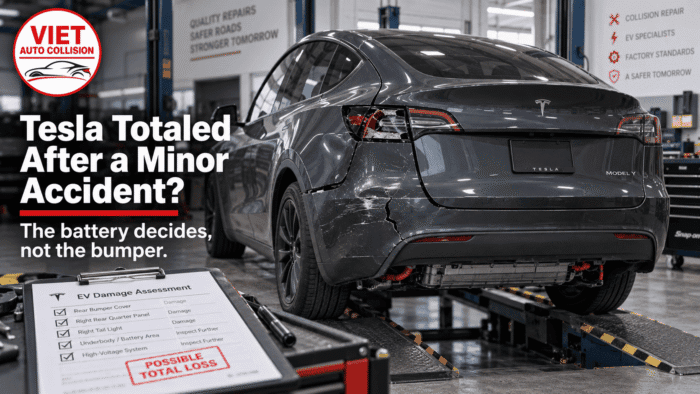
A customer brought in his Model Y a few months back with about $4,000 worth of visible damage. Cracked rear bumper cover, a bent quarter panel, one broken tail light. On almost any gas car we see with that kind of damage, that’s a two week repair and the customer drives home in a car that looks and drives exactly like it did before. On this one, the insurance company called it a total loss before we’d even finished writing the estimate.
He wasn’t upset about the payout. He was upset because nobody could tell him why. The car looked fine sitting in our lot. It drove in under its own power. As far as he could tell, the only thing wrong with it was cosmetic. What nobody explained to him, and what almost nobody explains to EV owners until it happens to them, is that the part of the car that actually decided whether it lived or died wasn’t the bumper at all.
Why a Scuffed Bumper Can Total an EV When It Wouldn’t Touch a Gas Car
We’ve been doing collision work for a long time, and the math on a gas car is pretty simple. You add up parts, labor, and paint, and you compare that number to what the car is worth. If repair costs less than the car, you fix it. Almost nothing about a rear bumper hit changes that math on a Camry or an F-150.
EVs break that math in two separate ways, and most owners only ever hear about one of them.
The Battery Pack Isn’t a Part, It’s the Floor
On a gas car, the structural floor is stamped steel. If it’s bent, we pull it on a frame rack, weld in a new section if needed, and measure it back to factory tolerance. It’s a repair we’ve done thousands of times.
On a growing number of EVs, especially the Texas and Berlin built Tesla Model Y, the battery pack itself is the structural floor. The cells aren’t sitting in a box bolted underneath the car, they’re bonded directly into the chassis as a load-bearing part of the vehicle. Automotive teardown analysts who’ve cut these packs apart for a living have called this design “zero repairability” once it’s been compromised, because there’s no bolted module to unclip and swap. It’s potted, sealed, and built to be assembled once.
When one of these comes into our bay after even a moderate rear hit, we’re not looking at a floor pan we can straighten. We’re looking at a sealed aluminum tray with cells glued into it, and no realistic way to open that tray, inspect individual cells, and put it back together as a vehicle we’d be comfortable putting our name on.
Insurers Won’t Gamble on Damage They Can’t Actually See
Even when the pack itself isn’t visibly cracked, an impact anywhere near it can shift cells, stress the cooling lines running through it, or create a micro-fracture that doesn’t show symptoms for weeks. A battery that develops a slow internal short after a “repaired” car goes back on the road is a fire risk, and an insurer that signed off on that repair is the one who gets sued if it happens.
Replacing a damaged pack outright, when replacement is even possible, isn’t cheap either. Industry repair cost reporting has put a full battery pack replacement on a mainstream EV like the Model 3 in the $15,000 to $20,000 range, on a car that can lose a third of its value the moment it’s a few years old. Once you put a number like that next to a car’s actual cash value, a lot of moderate-damage EVs cross the total loss line that a gas car with the same visible damage would never come close to.
Not Every EV Handles This the Same Way
This isn’t a universal EV problem, and we tell customers that directly because it changes what they should expect. The Texas and Berlin built Model Y, with its cell-to-chassis structural pack, is close to the worst case for repairability. Older Fremont built Model 3 and Model Y vehicles, along with most EVs from GM, Ford, Hyundai, and Kia, use a modular pack bolted underneath the floor rather than fused into it.
Modular doesn’t automatically mean repairable, though. Manufacturer repair procedures on most of these still call for replacing the entire pack rather than swapping an individual damaged module, and several manufacturers have started restricting who can even order structural EV parts. GM, for example, now limits certain front frame rail sections on its EV platforms to shops inside its own certified collision network. So the design difference matters, but it doesn’t fully solve the problem on its own, and it’s getting more restrictive, not less, as more of these cars age into the collision system.
Before we ever give a customer a repair or total loss opinion on an EV, one of the first things we check is which category their specific vehicle falls into, because “it’s electric” isn’t specific enough to answer the question by itself. If the pack clears that check, the actual repair process on an EV still differs from a gas car in several other ways we’ve walked through in more detail in our earlier piece on what a Tesla or EV collision repair actually involves, from parts sourcing to calibration after the bodywork is done.
What We Actually Check When an EV Comes Into Our Bay After a Collision
The first thing that happens with any EV on our lot, before a technician so much as opens a panel, is high voltage isolation, the same baseline safety step NHTSA’s own guidance on electric and hybrid vehicle safety flags for first responders and repair techs alike. In practice, that means a few things have to happen in order before a wrench ever touches the car:
- Confirm the service disconnect has been pulled and tagged, not just switched off
- Identify and physically stay clear of the orange high voltage cabling until it’s verified de-energized
- Wait out the manufacturer’s specified discharge time for onboard capacitors before opening anything near the pack
- Check for coolant leaks along the battery’s thermal management lines, since those loops run close to the pack edge on most platforms and a slow leak is easy to miss on a quick visual
Skip any one of those steps and you’re not looking at a fender bender anymore, you’re looking at a technician getting hurt. Once the car is confirmed safe to work around, we check the actual impact path against the battery pack’s real boundary, not just what’s visibly dented. A hit that stops well short of the pack footprint is a different conversation than one that reaches it, even if the visible damage looks similar from the outside.
More than once, we’ve told a customer their car was likely headed for total loss before their insurance adjuster had even shown up, purely based on where the impact landed relative to the pack. That’s not us trying to talk anyone into anything. It’s just that we’ve seen enough of these now to know which hits are a paint and panel job and which ones are a battery conversation, and we’d rather a customer hear that from us early than get blindsided by it two weeks into a claim.
The Real Numbers Behind the “EVs Get Totaled More” Assumption
Most people assume EVs get totaled at a dramatically higher rate than gas cars. The actual data is closer than that assumption suggests. Mitchell’s own Q1 2024 EV Collision Insights report put the U.S. total loss frequency for EVs at 9.93%, compared to 9.51% for comparable new gas powered vehicles over the same period. That’s a real gap, but it’s a small one, not the dramatic difference the “EVs just get totaled constantly” narrative implies.
What’s actually different isn’t how often EVs get hit hard enough to total. It’s what happens once they do. A comparable-severity hit on a gas car usually stays a repair, because the expensive parts are metal, glass, and labor, all of which have a known, bounded cost. On an EV, that same severity of hit has a real chance of reaching a component that’s either unrepairable by design or expensive enough to replace that it tips the cost-versus-value math on its own. The frequency of a serious hit is similar. What that hit is allowed to touch, and what happens once it does, isn’t.
What This Means Before You’re Ever in an Accident
Picking a Policy That Won’t Leave You Underwater
EVs depreciate faster in their first few years than most comparable gas vehicles, and combined with a total loss frequency that’s already close to gas cars, that’s a real gap-insurance conversation worth having before anything happens, not after. If you’re financing or leasing an EV, it’s worth asking your insurer specifically about a few things:
- Whether the policy includes gap coverage, or whether that needs to be added separately from your lender
- Whether there’s an EV-specific total loss or battery replacement rider, since some carriers now offer one
- How the insurer sources comparable-vehicle values for a car whose used market has been moving fast
Standard actual cash value payouts on a rapidly depreciating car can leave a real gap between what you owe and what you’re paid, and that gap is worth closing before you’re the one filing the claim.
What to Photograph and Save the Day It Happens
The evidence that actually helps you if a total loss determination gets disputed almost always gets created or lost in the first few days, not months later when you’re arguing with an adjuster. Worth keeping on hand from day one:
- Photos of the damage from multiple angles before anything gets touched or moved
- A copy of any pre-loss condition report or delivery inspection sheet, if you still have one
- The actual line-item damage estimate in writing, not just a verbal summary from the adjuster
The same documentation habits that matter for a diminished value claim on a repaired car matter here too, just earlier in the process.
If Your EV Does Get Totaled, What You Can Actually Do About It
A total loss determination isn’t automatically the final word. You’re entitled to request the specific damage assessment behind it, and if you have reason to believe the settlement value is off, you can get an independent appraisal rather than accepting the insurer’s first number. It rarely reverses a genuine battery-boundary hit, but it has changed the payout amount for customers we’ve worked with when the insurer’s comp-based valuation missed options or condition the car actually had. This is the same kind of claim pushback we help customers with as part of our collision and insurance claims work, EV or not.
If the car is declared a total loss, California Vehicle Code Section 11515 requires the insurer to process a salvage certificate through the DMV once the settlement is accepted, the same requirement that applies to a totaled gas car. Where EVs are different is what happens if that salvage title car gets rebuilt and resold. A rebuilt gas car’s frame and airbags can be inspected fairly directly, which is most of what decides whether a shop can straighten it back to factory tolerance in the first place. A rebuilt EV’s battery pack, the single component most likely to have been the actual reason it was totaled, is much harder for a buyer or even a shop to independently verify years later. That’s worth knowing whether you’re the one selling a totaled EV’s salvage remains or looking at a suspiciously cheap used one down the road.
Why did my insurance total my Tesla for such minor damage?
Because the damage most likely reached or came close to the battery pack, and on a structural-pack EV like a Tesla Model Y, insurers generally won’t approve a repair once that’s true. A pack that can’t be fully inspected for internal cell damage is a fire and liability risk they’re not willing to sign off on, even when the visible bodywork damage is minor.
Can a damaged EV battery pack be repaired instead of replaced?
Sometimes, but it depends entirely on the design. Modular packs used by GM, Ford, and some other automakers can occasionally have an individual damaged module addressed, though manufacturer procedures increasingly call for full pack replacement anyway. Structural, cell-to-chassis packs like the newer Tesla Model Y have no repairable path once compromised.
Are EVs actually totaled more often than gas cars?
Not by much. Mitchell’s Q1 2024 claims data put EV total loss frequency at 9.93% versus 9.51% for comparable new gas vehicles, a small gap rather than the dramatic difference most people assume. The real difference is what a serious hit is allowed to touch, not how often EVs get hit hard.
What should I do before I sign off on an EV total loss settlement?
Request the actual line-item damage assessment behind the number, not just the final figure, and get an independent appraisal if anything looks off, especially around condition or options the insurer’s valuation may have missed. Once you sign, that number is very difficult to revisit.
Is it safe to buy a salvage title or rebuilt EV?
Be more cautious than you would with a rebuilt gas car. A rebuilt EV’s battery pack, usually the actual reason it was totaled, is much harder for a buyer to independently verify than a frame or airbag repair. Ask specifically for battery health documentation and pack inspection records before buying one, not just a clean-looking title history.