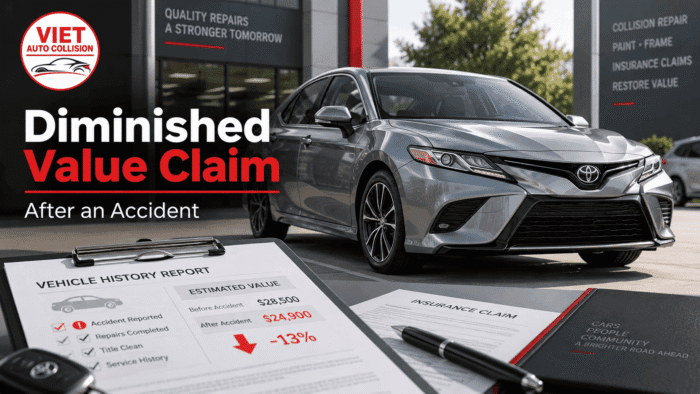
We get this call almost every week: the repair is done, the car looks perfect, the customer picked it up happy, and then a few weeks later they try to trade it in or sell it and the offer comes back lower than they expected. They call us confused, sometimes a little angry, asking why nobody told them the car would be worth less even after a good repair. The honest answer is that a well-repaired car almost always is worth less than the same car with no accident on its record, and there’s a specific claim for that loss. Most people just never hear about it until it’s too late to prove.
That claim is called diminished value, and it’s separate from the repair bill entirely. Insurance pays to fix the car. It doesn’t automatically pay for the fact that the car is now worth less simply because it has an accident in its history, or because a repair, however good, didn’t put it back to exactly what it was. Whether you can actually collect on that loss, and how much, comes down almost entirely to things that happen during the repair itself, not after.
What Diminished Value Actually Means (And the Two Different Kinds)
Diminished value is the gap between what your car was worth the day before the accident and what it’s worth after it’s been repaired. Even a repair done to factory spec with genuine OEM parts and a perfectly matched paint job doesn’t erase the fact that the car now has an accident on its history report. Buyers pay less for that car, full stop, and that gap is a real, recoverable financial loss under California law, not just a hypothetical one.
There are actually two different claims hiding under that one term, and mixing them up is the first mistake we see people make.
Inherent diminished value
This is the loss that exists purely because the car now has an accident on its Carfax or AutoCheck record, even if the repair itself was flawless. It’s the “stigma” loss. A future buyer or a dealer running a history report will offer less for that VIN than an identical car with a clean history, regardless of how good the bodywork actually is.
Repair-related diminished value
This is a separate, narrower claim for value lost because the repair itself fell short: color that’s slightly off on a blended panel, panel gaps that aren’t quite factory tight, aftermarket parts where OEM was expected, or structural work that technically passes inspection but wasn’t done to the vehicle’s original engineering tolerance. We see this distinction get lost constantly. A customer will describe a repair-quality complaint using inherent diminished value math, or vice versa, and the two require completely different proof.
Who Can Actually File This Claim (Usually Not Against Your Own Policy)
This is the part that surprises people the most, and it’s worth being direct about it instead of hedging.
If you caused the accident
You almost certainly cannot collect diminished value from your own insurer. Most standard California auto policies, including collision coverage, are written to restore the vehicle to its pre-loss condition, not to compensate for a value gap that remains after a proper repair. A handful of insurers make limited exceptions, but don’t count on it. If you’re at fault, this claim is essentially closed against your own policy.
If the other driver was at fault
This is where the claim actually works. According to the Insurance Information Institute, every state except Michigan allows a not-at-fault driver to recover diminished value from the at-fault driver’s liability insurer. In California, this isn’t just industry custom, it’s backed by an actual jury instruction, CACI No. 3903J, which the Judicial Council revised in 2016 specifically to support recovering the difference between a car’s value before the harm and its lesser value after repairs, on top of the repair cost itself. That’s the legal foundation an adjuster is working against whether they volunteer that information or not, and in our experience, most don’t volunteer it.
One more detail almost nobody mentions until it’s a problem: you have three years from the date of the accident to bring this claim in California, under the statute of limitations for injury to personal property, Code of Civil Procedure Section 338(c). That sounds like plenty of time, but the evidence that actually wins these claims gets harder to reconstruct every month that passes, which is the whole point of the next section.
What Actually Happens in the Bay That Either Helps or Kills This Claim Later
Here’s what almost no law firm blog or insurance FAQ tells you, because they’re not the ones standing at the estimate counter: the evidence that makes or breaks a diminished value claim gets created or thrown away during the repair itself, weeks or months before anyone thinks about filing anything. We’ve had customers come back six months later wanting to file, and the honest answer is sometimes there’s nothing left to work with because nobody asked us to document anything at intake.
The parts paper trail
Genuine OEM parts versus aftermarket parts isn’t just a repair-quality argument, it’s diminished value evidence. An itemized estimate showing OEM sheet metal, OEM lamps, and OEM structural components supports a much stronger claim than one showing generic aftermarket parts, because an appraiser comparing your car to a clean-history comparable is going to assume factory parts unless the paperwork says otherwise. We keep our parts invoices itemized by part number specifically because customers sometimes need that six months or a year later and have no idea to ask for it at drop-off.
Pre-repair photos and the original estimate
A diminished value appraiser needs to know exactly what was wrong with the car before it went into the bay, not just what the finished repair looks like. We photograph every panel, every point of impact, and every piece of trim we remove before a single tool touches the car, partly for our own liability and partly because that photo set is often the only surviving proof of how bad the damage actually was. Insurers will sometimes lowball a diminished value claim by implying the damage was cosmetic. A clear pre-repair photo set and the original written estimate showing the actual scope (hidden frame damage, suspension components, structural adhesives) is what closes that argument.
Frame and structural repair records
If a frame or unibody rail was pulled, measured, and brought back within factory tolerance, that measurement printout is worth keeping. It proves the structure was verified, not just eyeballed, which matters enormously to a future buyer’s mechanic doing a pre-purchase inspection and to an appraiser deciding whether structural work should push the diminished value number higher. Nobody thinks to ask for this printout at pickup. We hang onto ours specifically because it comes up.
Why the Insurer’s First Number Is Usually Wrong
If an adjuster does offer something for diminished value without a fight, there’s a good chance they’re using something called the 17c formula, and it’s worth knowing exactly where that number comes from before accepting it.
The 17c formula wasn’t created by any state insurance department or by California law. It originated as a courtroom shortcut in a Georgia class-action settlement, State Farm Mutual Automobile Insurance Co. v. Mabry, where a court needed a fast way to process tens of thousands of individual claims at once rather than appraise each vehicle individually. It caps the maximum possible diminished value at 10% of the vehicle’s pre-loss value, then applies further deductions for mileage and prior damage history on top of that cap. It carries no legal authority in California and was never intended to be an accurate, case-by-case appraisal method, just an administrative average for a mass settlement in a different state entirely.
California’s actual legal standard, under CACI 3903J, is the real difference between the car’s fair market value before the accident and its actual fair market value after the repair, established the way any other property value dispute is proven: comparable sales, professional appraisal, and the documentation described above. That number is very often higher than what a 17c-based offer produces, sometimes considerably higher on a car with real structural work or a full panel replacement. We’ve had a customer come back to us holding a low three-figure 17c-based offer on a car where we’d handed over a full frame-pull measurement printout at pickup, and once that printout and the OEM parts invoice went into the appeal, the number moved considerably. The paperwork sitting in our file is usually what actually moves it, not the phone call.
How Much Is Actually at Stake
The numbers here vary a lot by vehicle, but they’re not trivial. Carfax’s own accident-history pricing data puts the average retail value hit from an accident on record at roughly $500, and that climbs to around $1,700 for a vehicle with more severe documented damage, with wholesale value impacts running even higher, over $1,000 on average and nearing $2,300 for severe damage. Those are averages across all vehicle types and price points, so a newer or higher-value vehicle with a well-documented structural repair can land well above those figures once appraised individually.
- Late-model vehicle, cosmetic panel and paint repair only: diminished value claims tend to land on the lower end of that range.
- Vehicle with a documented frame pull or structural repair, even fully within tolerance: this is where a properly documented claim, not a 17c estimate, tends to separate from a lowball offer the most.
- Vehicle already several years old with high mileage: expect a smaller number. Buyers researching an older car are already pricing in wear, so an accident history moves the needle less than it does on a newer vehicle.
Filing the Claim: What Actually Works
The process itself isn’t complicated, but the order matters.
- Gather the repair-side documentation first, before you contact the insurer: itemized parts invoice, pre-repair photos, the original written estimate, and any frame or structural measurement printout. If your shop didn’t automatically provide these, ask, most keep them on file even if they weren’t handed over at pickup.
- Get an independent diminished value appraisal rather than accepting the insurer’s in-house number outright. A qualified independent appraiser will compare your specific vehicle, mileage, and documented repair scope against real comparable sales, not a generic percentage formula.
- Submit a written demand to the at-fault driver’s insurer referencing CACI 3903J and including the appraisal and repair documentation, not just a request for “diminished value” with no backup.
- Negotiate from the appraisal, not the offer. If the insurer counters with a 17c-based number, point directly to the documentation showing why your specific vehicle’s loss exceeds that generic formula.
- Know when it’s worth escalating. For smaller claims, California small claims court has jurisdiction up to a set dollar limit and doesn’t require an attorney. For larger claims involving significant structural work, a consultation with an attorney who handles property damage claims is usually worth the conversation before you settle for less than the documentation supports.
We’re not able to file this claim for you, and we’re honestly not the right people to negotiate it since we’re not adjusters or appraisers. What we can do, and what we tell every customer whose car has real structural or frame work done, is keep the documentation that makes the difference between a supportable claim and an insurer’s opening lowball. That’s the part of this process that actually happens in a body shop, and it’s the part almost nobody thinks to ask about until it’s already too late to reconstruct.
Can I file a diminished value claim if the accident was my fault?
Almost never against your own policy. Standard California collision coverage is written to restore the car to its pre-loss condition, not to pay for value lost after a proper repair, so an at-fault claim against your own insurer for diminished value is essentially a dead end.
How long do I have to file a diminished value claim in California?
Three years from the date of the accident, under California’s statute of limitations for injury to personal property, Code of Civil Procedure Section 338(c). Waiting that long is legally allowed but makes the claim much harder to prove, since repair documentation and pre-repair photos get harder to track down the further out you go.
Does insurance automatically pay diminished value?
No, you have to request it and usually document it yourself. Adjusters aren’t required to volunteer a diminished value offer, and when they do, it’s often based on the 17c formula, a Georgia courtroom shortcut with no legal standing in California, rather than an actual individual appraisal of your car.
What’s the difference between inherent and repair-related diminished value?
Inherent diminished value is the loss from simply having an accident on the car’s history record, even with a flawless repair. Repair-related diminished value is a separate claim for a repair that itself fell short, like an off-color blend or panel gaps that aren’t factory tight, and it requires different proof than an inherent claim does.
Do I need a lawyer to file a diminished value claim?
Not always. Smaller claims can often go through California small claims court without an attorney, and some drivers negotiate directly with a solid independent appraisal in hand. For larger claims involving real structural or frame repair, a short consultation with an attorney who handles property damage claims is usually worth it before accepting a lowball offer.
If your car has real structural or frame work in its repair history, not every damaged frame ends in a total loss, and the same documentation that determines whether a car gets totaled is exactly what an appraiser needs to support a diminished value claim on a car that stays on the road. If your car was towed from the accident scene before it ever reached a shop, the fees and rights around that tow happen on a completely separate clock from anything described here, worth knowing so one doesn’t get confused for the other. And if the shop that repaired your car offered a workmanship warranty, it’s worth understanding what that warranty actually covers and when it ends, since warranty paperwork and diminished value documentation often come from the same repair file.
We handle insurance claims documentation as part of every repair that comes through our collision repair bay, specifically because customers don’t always know what they’ll need later, and by the time they do, the evidence is often already gone.